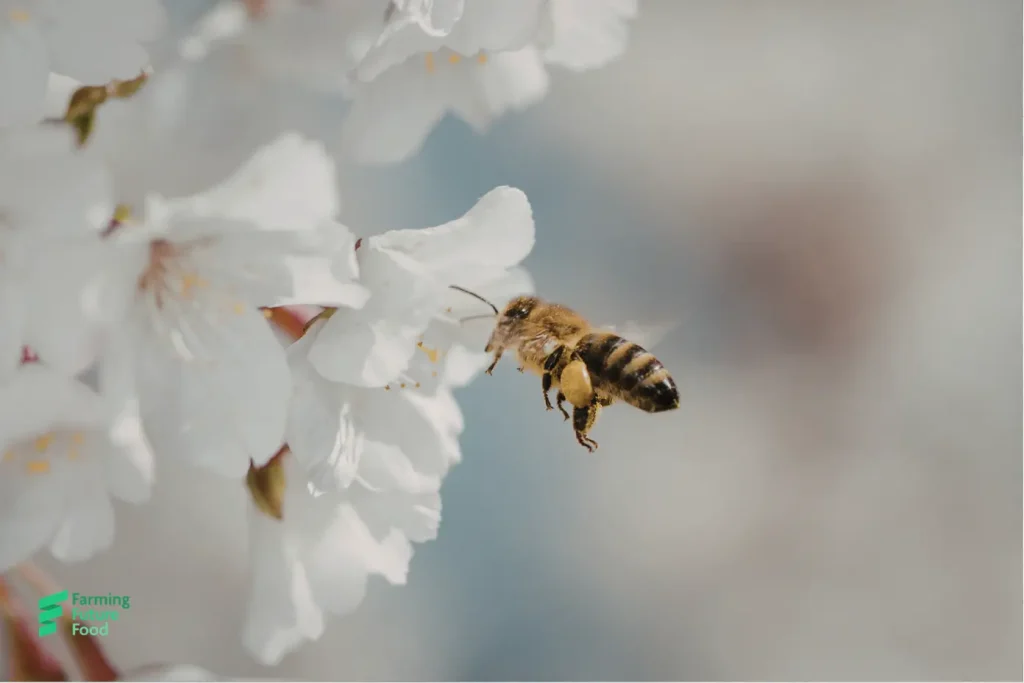
Distributing pollen collected by bees over crops using drones could offer a novel solution to the global pollination crisis.
Pollination is essential for many globally important crops, but conventional pollination is under threat due to declining pollinator numbers, lower pollination availability and changeable weather conditions.
Researchers in China tested an integrated approach to address this, distributing pollen over three pear orchards in Shanxi province using a specialised drone and preprogrammed navigation paths designed for full coverage of flowers.
First, though, they set out to find out whether pollen collected by bees or manually collected pollen would work best in the solution needed for drone application.
Why bee-collected pollen performed better
In tests of the pollens’ suspension in solution, they found that the density of bee-collected pollen was consistently more stable and evenly distributed of the solution. This is due in part to the 10% honey which is found in bee-collected pollen, with the soluble sugars increasing the solution’s density and reducing its sedimentation.
The team also worked to optimise pollination germination by testing the impact of different concentrations of components. They found that boron concentrations were essential for optimal germination. They found the element occurring naturally in bee-collected pollen in the form of boric acid but not in manually collected pollen, and optimised levels in their solution, as well as incorporating signalling proteins as a germination aid.
Significant increases in fruit set
The qualities of bee-collected pollen combined with the teams’ additives and the use of drones brought advantages in the orchards. The approach significantly improved fruit set over the three years of the study, from 23.64 %, 24.06 % and 22.79 % in the upper, middle and lower layers of the canopy to 79.94 %, 60.50 % and 52.35 %, respectively. Extending the study to look at using the approach with apple, almond and apricot crops, they observed similarly significant improvements.
Challenges in pollen distribution
The work also brought some observations about how pollen in solution is distributed over crops, finding that some variability remains when using drones for pollination. Upper canopy layers nearest the drone received the highest pollen dispersal, while other factors relating to the technology such as drone speed, altitude and spray volume can also affect success. The team called for further investigation of strategies to get the best out of drone pollination but also pointed to the successful proof of concept.
“This method offers a promising alternative to traditional pollination techniques and has the potential to address global challenges of the decline and crisis in pollinator insects, the labour-intensive nature of hand pollination, and the high costs associated with conventional pollination methods,” the researchers wrote in Journal of Cleaner Production.
A hybrid future for pollination technologies?
Advancements in robotics for pollination, such as autonomous microbots, have often been mooted as a possible outright replacement for insects in the face of pollinator declines. The research suggests that things need not be so binary.
“This approach offers an effective solution to the pollination crisis and boosts agricultural productivity,” the scientists added.
Key takeaways
- Drone-distributed bee pollen significantly improved fruit set in pear orchards.
- Bee-collected pollen suspended more evenly than manually collected pollen.
- Natural honey and boron improved pollen stability and germination.
- Similar pollination gains were observed in apples, almonds and apricots.
- Researchers see drones complementing, rather than replacing, insect pollinators.
If you’re interested in the use of drones in agriculture, you might also like our stories on identifying genetic traits in cereal crops and the European race for drone roll-out.
Want to read more stories like this? Sign up to our newsletter for bi-weekly updates on sustainable farming and agtech innovation.