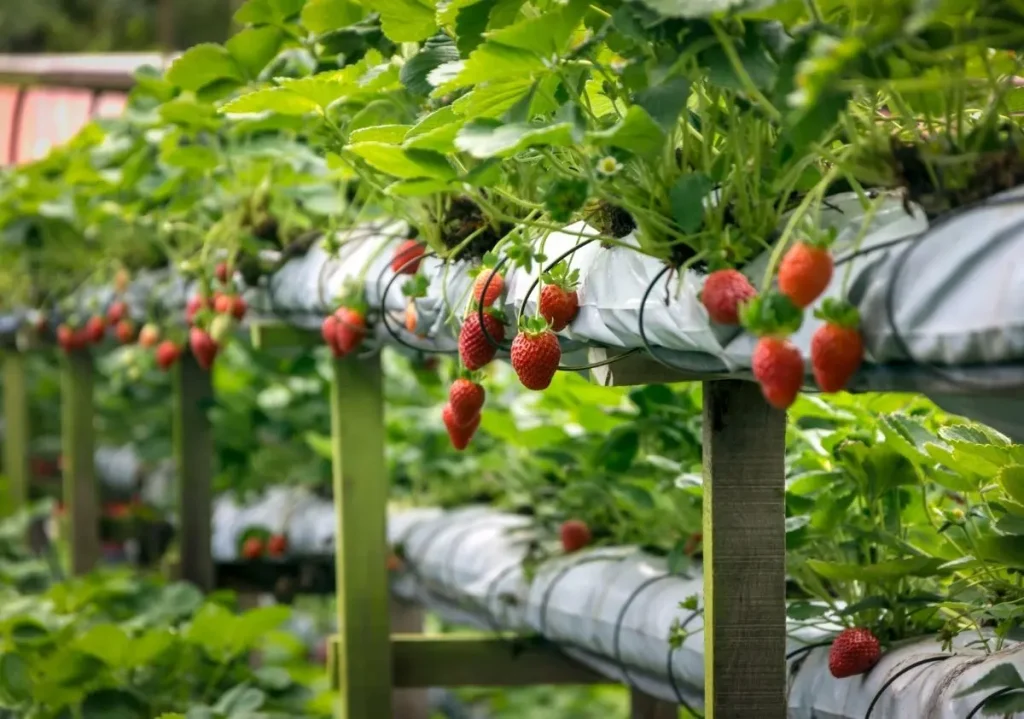
An irrigation system used by berry growers could double up as a delivery tool for biological pest control, helping tackle one of the sector’s most difficult insects, according to research from the University of California and USDA scientists.
The study found that entomopathogenic nematodes — microscopic worms used as biopesticides — can be successfully applied through drip irrigation systems to target spotted wing drosophila (SWD), a major pest of soft fruit crops worldwide.
SWD has become a costly and persistent challenge for growers of raspberries, blueberries and cherries. Unlike many fruit flies, it attacks ripening fruit, forcing farmers to rely heavily on insecticides.
That approach is becoming less reliable, with resistance to commonly used chemistries already reported, alongside concerns about secondary pest outbreaks and environmental impact.
Distributing nematodes
The team investigated whether the nematode Steinernema carpocapsae could be delivered through standard drip irrigation systems already used in commercial berry production.
They carried out a series of lab, semi-field and on-farm trials in raspberry and blueberry crops, testing whether the nematodes could pass through irrigation filters and emitters, survive the delivery procesS, and infect SWD larvae and pupae in realistic conditions
The results, published in the journal Biological Control, showed that drip irrigation can successfully distribute nematodes into the soil, where SWD larvae and pupae are present.
In lab tests, the nematodes infected up to 48% of SWD individuals under controlled conditions.
In semi-field trials, nematodes delivered via drip systems infected around 7.6–11.8% of SWD pupae, with no infection in untreated controls.
Field results were more variable, but still confirmed that nematodes could move through irrigation lines and infect insects under commercial conditions. However, infection levels in SWD were generally low and not always significantly different from untreated plots.
By contrast, infection rates in waxworms — a standard test insect — were much higher, reaching up to 53% in field trials, showing the delivery system itself was effective.
Design matters
Drip irrigation offers a targeted way to deliver biological agents directly into the soil, where SWD larvae pupate after leaving fruit.
The study also found that system design matters. Filters that are too fine can block nematodes — for example, 200-mesh filters significantly reduced passage, while 120-mesh filters allowed more than half of nematodes through.
Encouragingly for growers, distance along irrigation lines had little impact on how evenly nematodes were distributed in most cases, suggesting the approach could work across commercial-scale fields.
Why does it matter for farmers?
Drip irrigation is already widely used in berry production because it improves water efficiency and reduces disease pressure.
Using the same system to apply biocontrol agents could reduce labour costs and simplify integration into existing farm operations.
The approach also fits with wider efforts to reduce reliance on chemical insecticides and build more sustainable pest management systems.
Further research needed
Despite the promising results, the researchers cautioned that field performance still needs improvement before widespread adoption.
SWD infection rates were inconsistent and influenced by environmental factors such as soil moisture, temperature and the age of the pest at treatment.
There are also practical challenges, including potential clogging in irrigation systems and uneven distribution caused by leaks or pressure differences.
The researchers said further work is needed to optimise application rates, timing and irrigation setup to achieve reliable pest control in the field.
They concluded that drip irrigation systems “can evenly deliver nematodes” and support infection of SWD, but that achieving consistent, economically viable control will require refinement.
Key takeaways
- Nematodes can be delivered through standard drip irrigation systems to target soil-dwelling stages of spotted wing drosophila.
- Lab trials showed infection rates of up to 48%, but field performance was lower and more variable.
- Filters matter: 120-mesh systems allowed nematodes through, while finer filters reduced delivery.
- Distance along irrigation lines had little effect on distribution, suggesting suitability for commercial-scale use.
- Further optimisation is needed to improve consistency and make the approach economically viable for growers.
Want to read more stories like this? Sign up to our newsletter for bi-weekly updates on sustainable farming and agtech innovation.